Atharva Bhorpe · Project
Cost-effective AMR — RBot
A student-built ROS platform intended for low-cost robotics education and research.
- Role
- Integrating the ROS stack with Arduino firmware on ESP32
- Tools
- ROS · Arduino · ESP32 · Fusion 360
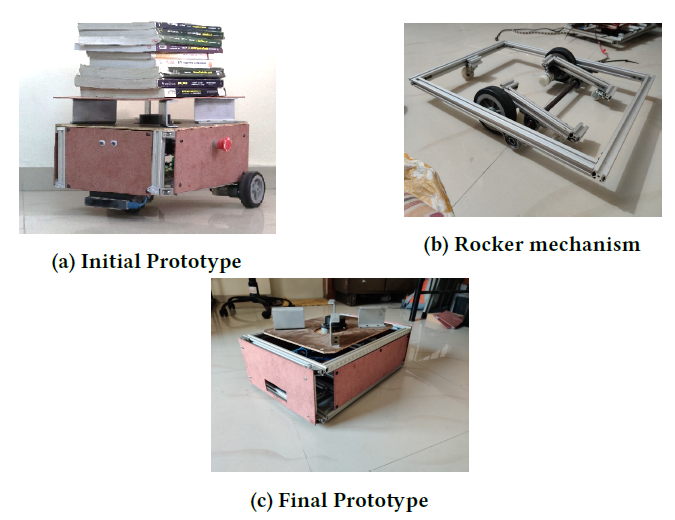
Problem and objective
Many mobile robots use expensive or proprietary hardware and software. RBot was designed as an affordable, modifiable platform for education, research and development.
This final-year college project involved five students: three from electronics and two from mechanical engineering. The supplied design portfolio describes LiDAR, tracking and depth cameras, and an IMU for SLAM and autonomous navigation.
My contribution and approach
I integrated the ROS stack with the robot firmware, written with Arduino on an ESP32.
The team designed the robot in Fusion 360. Its chassis uses 20×20mm aluminium profiles, and its casing uses waterproof MDF board. The design allows changes to the electronics and actuator selection.
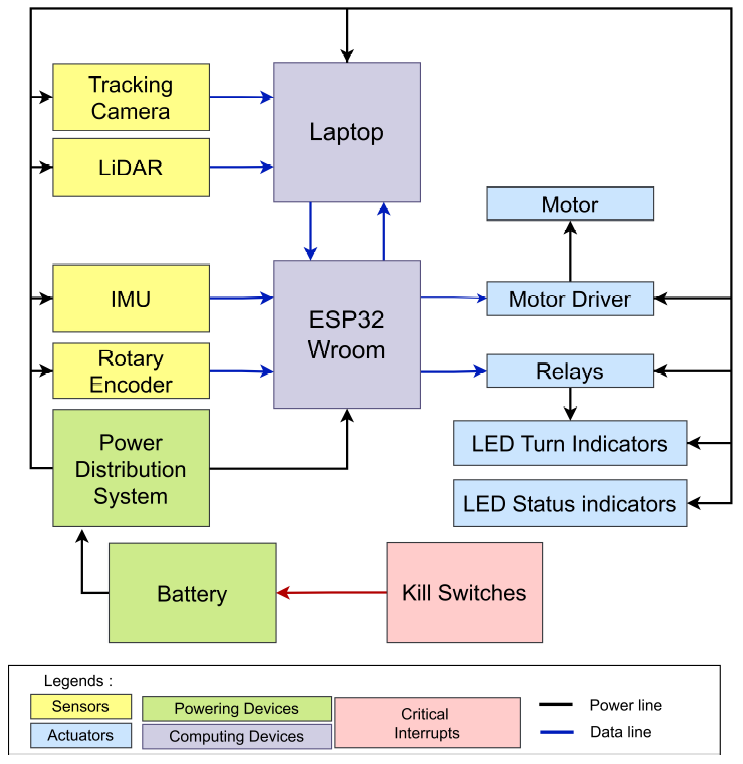
Reported results and limitations
The team timed the robot over a dedicated 10-metre test track with varied payloads. The recorded travel times were used to estimate speed.
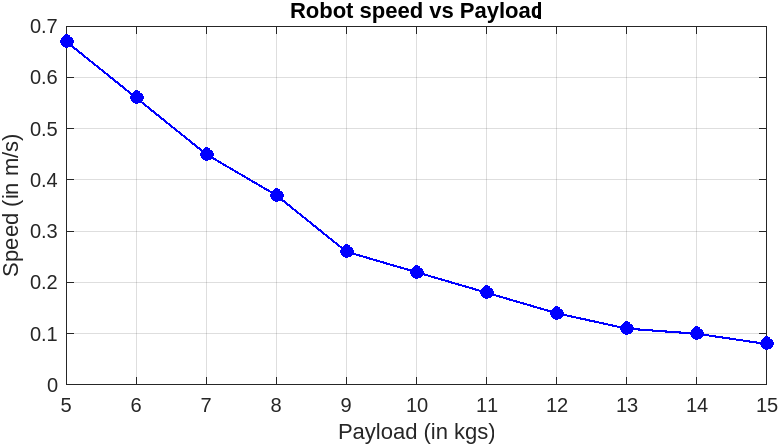
The PDF reports a prototype and a performance test, not a production deployment. These tests have not been independently reproduced for this portfolio.
The author confirms that the final laptop-based robot carried 5kg at 0.3m/s. This is an author-reported measurement, not an independent reproduction. The 10-metre track remains the documented test method; no additional timing or budget values are inferred.
Source record
This case study uses the project text and figures in the two-page design portfolio supplied by the author. Only the project figures are included here; the source PDF is not published.
Sources and evidence
Source: author-supplied design portfolio, project text and figures. The source PDF is not a public download. No public code or raw test data was supplied.